
 If you’ve researched hair loss treatments, you’ve likely seen two main categories: oral medications and topical solutions. Both have solid clinical track records and are routinely prescribed for androgenic alopecia, the most common form of hair loss in men and women. But here’s something many people miss: using one without the other often leaves real results on the table. The combination approach, pairing an oral DHT blocker with a topical growth stimulant, addresses hair loss at two distinct biological levels simultaneously. This guide explains how each treatment works, why they complement each other so well, and how to access a medically supervised combination plan online.
Understanding Oral vs. Topical Hair Loss Treatments: What Each One Does
How Oral Hair Loss Medications Work
Oral hair loss medications work systemically, meaning they circulate through the bloodstream and act on the hormonal root cause of most patterned hair loss. The most established oral option is finasteride, a 5-alpha reductase inhibitor that reduces dihydrotestosterone (DHT) levels. DHT is the primary hormone responsible for shrinking hair follicles in genetically susceptible individuals. By lowering DHT levels throughout the body, finasteride slows follicle miniaturization and, in many patients, partially reverses it.
Oral minoxidil is a newer but increasingly popular option. Originally a blood pressure medication, minoxidil, when taken orally in low doses, has shown meaningful hair regrowth, particularly for diffuse thinning that does not respond well to topical application alone. At doses of 0.625 mg to 2.5 mg daily, it dilates blood vessels, thereby improving nutrient supply to hair follicles across the entire scalp.
How Topical Hair Loss Treatments Work
Topical treatments work locally, applying active ingredients directly to the scalp where thinning is occurring. Topical minoxidil, available in 2% and 5% concentrations, is one of the most studied hair loss treatments in history. It extends the anagen (growth) phase of the hair cycle and increases follicle size, which results in thicker, longer strands over time.
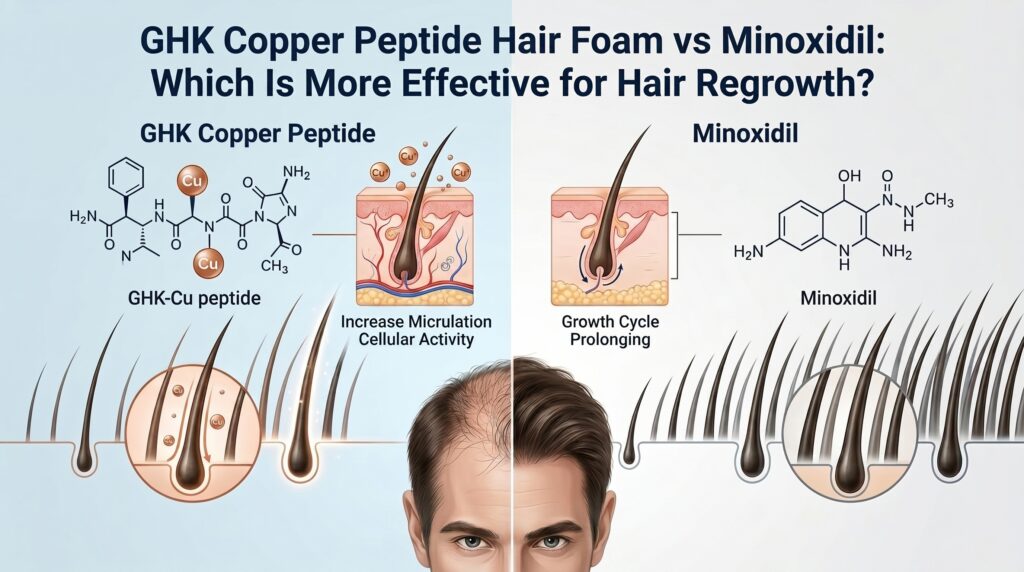
More recently, topical formulas containing GHK copper peptides have entered clinical use. These peptides signal the scalp to upregulate collagen and elastin production around the follicle, support dermal papilla cell health, and reduce inflammation that can contribute to follicle damage. When delivered in a foam or serum vehicle, they penetrate the scalp efficiently without the systemic effects associated with oral medications.
Oral vs. Topical Hair Loss Treatments: Side-by-Side Comparison
Here is a clear look at how the two approaches differ and where they overlap:
|
Feature |
Oral (Finasteride / Oral Minoxidil) |
Topical (Minoxidil / Peptide Serum) |
|
Primary Action |
Blocks DHT systemically |
Stimulates follicle blood flow locally |
|
Onset of Effect |
3 to 6 months |
2 to 4 months |
|
Coverage |
Whole scalp via bloodstream |
Applied area only |
|
Best For |
Androgenic alopecia (hormonal) |
Diffuse thinning, patterned loss |
|
Side Effect Profile |
Low; systemic consideration |
Minimal; localized irritation possible |
|
Prescription Needed |
Yes |
Depends on strength |
|
Combined Benefit |
Strongest results when paired |
Strongest results when paired |
Why the Combination Approach to Hair Loss Treatment Outperforms Either Option Alone
Attacking Hair Loss at Two Separate Biological Levels
Hair loss driven by androgenetic alopecia has two main components: a hormonal signal that shrinks the follicle and a vascular and cellular environment that no longer adequately supports growth. An oral DHT blocker addresses the hormonal signal. A topical treatment addresses the local environment. Doing one without the other means one half of the problem remains unaddressed.
Clinical studies evaluating finasteride plus topical minoxidil consistently show greater improvements in hair count than either treatment used in isolation. A 2021 meta-analysis published in the Journal of the American Academy of Dermatology found that combination regimens yielded statistically significant increases in total hair count compared with monotherapy, particularly in men with moderate to advanced hair loss.
What Faster, More Visible Results Actually Mean for Patients
One of the most practical arguments for the combination approach is speed. Hair restoration is a slow process regardless of what you use, and many patients lose confidence and discontinue treatment before seeing results. Combination therapy tends to produce visible changes earlier, which matters enormously for adherence. Patients who see shedding slow down within the first 60 to 90 days are far more likely to stay consistent through the 6- to 12-month window when real regrowth becomes visible.
Timeline Expectations With Combination Treatment
- Months 1 to 2: Reduced shedding as the DHT suppression takes effect
- Months 2 to 4: Scalp coverage begins to stabilize; finer hairs may start to emerge
- Months 4 to 6: Visible regrowth in previously thinned areas for most patients
- Months 6 to 12: Continued thickening; maximum benefit typically seen around the 12-month mark
- Beyond 12 months: Maintenance; ongoing use preserves and can continue to improve results
It is worth noting that these timelines assume consistent daily use. Skipping doses or stopping treatment prematurely is the single most common reason patients report poor outcomes.
Green Cap Health’s Combination Hair Regrowth Products: What’s Available
Green Cap Health is a licensed US telehealth practice that prescribes actual medications, not vitamins or supplements, for hair loss in men and women. Their hair regrowth product lineup is specifically built around the combination principle, pairing oral and topical prescription formulas for eligible patients.
Hair Growth Combo of Capsules and Serum for Men and Women
Green Cap Health’s Hair Growth Combo, consisting of Capsules and Serum, is one of their most prescribed hair regrowth plans. Starting from $59.99 per month, it pairs an oral capsule formulation with a topical serum in a single coordinated protocol. Both components are compounded at an FDA-registered US pharmacy and formulated at therapeutic doses rather than the subclinical concentrations found in most over-the-counter supplements.
This combo is designed for both men and women experiencing patterned hair thinning. The oral component targets the hormonal drivers of hair loss; the serum targets the follicular environment directly at the scalp. Together, they provide dual-mechanism coverage that makes combination treatment far more effective than using either alone.
GHK Copper Peptide Hair Growth Foam
For patients who want a topical-first approach or are not candidates for oral finasteride, the GHK Copper Peptide Hair Growth Foam is a prescription-strength topical option that delivers peptide-based follicle support in a convenient foam format. GHK-Cu has shown meaningful results in peer-reviewed research for improving hair density and reducing scalp inflammation. It can also be used alongside oral treatments for those who want comprehensive coverage.
How the Prescription Process Works
There are no referrals, no dermatology waitlists, and no in-person appointments required. The process takes under two minutes. You complete a short health questionnaire about your hair loss pattern and medical history. A licensed US provider reviews your submission, typically the same day, and prescribes a treatment plan matched to your specific situation. Your prescription is then compounded and shipped discreetly to your door. Ongoing provider access is included for questions during your treatment.
Is the Combination Approach Right for You? Key Considerations
Candidates Who Typically Benefit Most From Combination Hair Loss Treatment
- Adults experiencing androgenic alopecia, whether at early or moderate stages
- Men with a receding hairline or crown thinning who have not yet tried prescription treatment
- Women with diffuse thinning, particularly postpartum or perimenopausal
- Patients who have tried topical minoxidil alone and plateaued in their results
- Anyone who wants to start with the most effective evidence-based approach, rather than stepping through each therapy one at a time
When You Should Speak to a Provider Before Starting
- You have a history of low blood pressure or are taking antihypertensive medications.
- You are pregnant, planning to become pregnant, or breastfeeding.
- You have liver disease or a history of certain hormonal conditions.
- You are unsure whether your hair loss has a non-androgenic cause, such as thyroid disease or nutritional deficiency.
These are not necessarily disqualifying factors, but they are reasons to have a real conversation with a licensed provider rather than self-treating. Green Cap Health’s consultation process exists precisely for this purpose.
5 Things to Know Before Starting a Combination Hair Loss Plan
- Consistency matters more than any single ingredient. Daily use, without breaks, is the foundation of any successful hair regrowth protocol.
- Results are not permanent if you stop. Combination treatment manages the underlying condition. Discontinuing treatment typically leads to a gradual reversal of gains.
- Shedding in weeks 2 through 6 is normal and is called the telogen effluvium phase. It does not mean the treatment is failing.
- A licensed provider should evaluate your hair loss pattern before you start. What looks like androgenic alopecia is occasionally something else entirely, and misdiagnosis leads to wasted time and money.
- Prescription-strength formulations are meaningfully different from what you find at the pharmacy or online without a prescription. Therapeutic dosing matters.
The Bottom Line on Oral vs. Topical Hair Loss Treatments
The debate between oral and topical hair loss treatment largely dissolves once you understand that they do different things. Oral medications reduce the hormonal signal driving follicle miniaturisation. Topical treatments restore the local scalp environment that growing follicles depend on. Together, they provide a level of coverage that neither approach alone can match.
For most people dealing with androgenic alopecia, the combination approach is not a luxury option. It is simply the most logical way to address all the biological factors contributing to hair loss at once. The evidence supports it, and the clinical experience of providers who specialise in this area supports it too.
Green Cap Health makes combination hair regrowth treatment accessible to men and women across Texas through licensed telehealth consultations, prescription-strength formulations, and discreet home delivery. If you are ready to explore your options, their hair regrowth treatment page at greencaphealth.com/hair-regrowth is the place to start.
Frequently Asked Questions
Q: Is it safe to combine oral and topical hair loss treatments at the same time?
A: For most healthy adults, yes. Oral finasteride and topical minoxidil have been used together for decades with a well-established safety record. Oral minoxidil combined with topical peptide serums is a newer but increasingly prescribed combination. A licensed provider should review your health history before prescribing any combination regimen.
Q: How long does it take to see results with a combination hair loss treatment?
A: Most patients notice reduced daily shedding within two to three months. Visible regrowth in thinning areas typically appears between months four and six. The most substantial improvements generally occur between months nine and twelve. Continuing treatment beyond 12 months usually produces further density gains.
Q: Do I need a prescription for a combination hair loss treatment?
A: Oral finasteride and prescription-strength minoxidil require a prescription. Some topical minoxidil formulas are available over the counter at lower concentrations, but compounded prescription versions offer more tailored dosing. Green Cap Health’s combination products are prescription-based and reviewed by a licensed provider for each patient.
Q: Can women use oral and topical hair loss treatments together?
A: Yes, though the specific medications differ from those commonly prescribed to men. Oral minoxidil at low doses is well-tolerated by women and is increasingly prescribed for female pattern hair loss. Topical minoxidil and peptide serums are also appropriate for women. Finasteride is generally not prescribed for premenopausal women due to potential hormonal effects. A provider consultation clarifies the best approach based on your individual situation.
Q: Can I get a hair-loss prescription online without visiting a clinic?
A: Yes. Green Cap Health offers fully online consultations for patients in Texas. After completing a short health form, a licensed provider reviews your case and, if appropriate, prescribes a combination treatment plan. Your medication is compounded at a US-licensed pharmacy and delivered directly to your door. You can start at greencaphealth.com/hair-regrowth.
Q: What is the difference between compounded and commercial hair loss medications?
A: Compounded medications are custom-formulated by a licensed pharmacy, allowing for specific dose combinations and delivery formats not available in standard commercial products. This is particularly useful for combination therapies, where a single product can include both a DHT blocker and a growth stimulant at personalized concentrations. All of Green Cap Health’s compounded formulas are prepared at FDA-registered US pharmacies.
Advance Your Longevity Journey
Our clinical team provides personalized senolytic assessments based on the latest research protocols.