
If you are dealing with thinning hair or early signs of hair loss, you have likely come across two names more than once: GHK copper peptide hair foam and Minoxidil. Both are widely discussed in dermatology circles and hair care communities, yet they work in fundamentally different ways. Understanding which one actually works better for hair regrowth requires a clear look at the science, not just marketing claims. This guide breaks down both treatments honestly, so you can make an informed choice based on your specific hair loss pattern, scalp health, and lifestyle.
What Is GHK Copper Peptide Hair Foam?
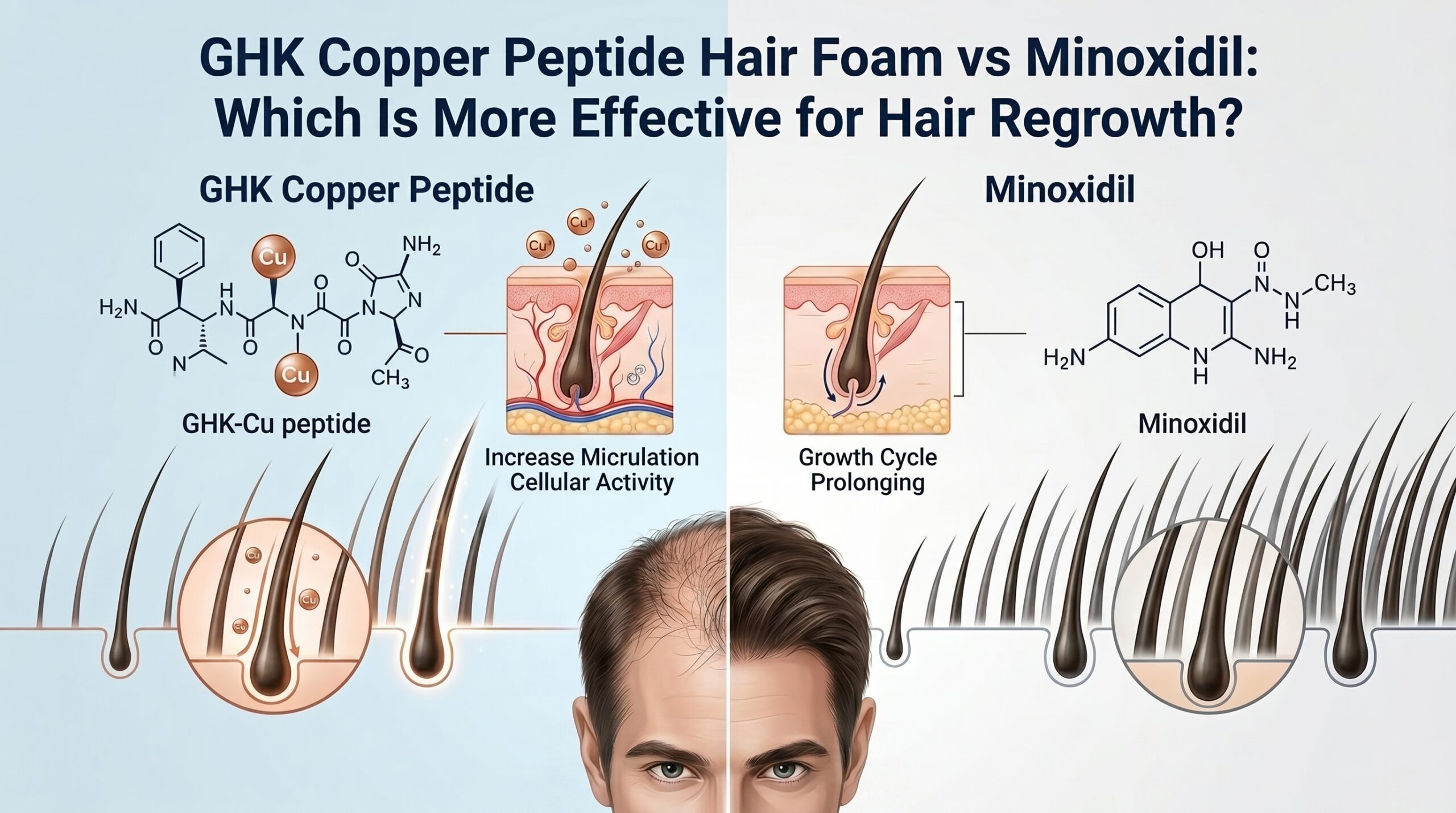
GHK-Cu, short for glycyl-L-histidyl-L-lysine copper, is a naturally occurring copper complex found in human blood, saliva, and urine. It was first identified in the 1970s and has since attracted significant research attention for its role in wound healing, skin repair, and, more recently, hair follicle health.
In topical form as a hair foam, GHK copper peptide penetrates the scalp and interacts directly with hair follicle cells. Studies published in journals such as the Archives of Dermatological Research suggest that GHK-Cu can increase follicle size, prolong the anagen (growth) phase of the hair cycle, and reduce scalp inflammation that often underlies androgenetic alopecia.
Unlike pharmaceutical interventions, copper peptides work at a biological level by signalling repair processes in damaged tissues. This makes them particularly appealing for people experiencing stress-related hair thinning, post-illness shedding, or early-stage pattern hair loss, in which follicles are weakened but not yet dead.
What Is Minoxidil and How Does It Work?
Minoxidil is an FDA-approved topical treatment for hair loss and one of the most clinically studied options available without a prescription. Originally developed as an oral antihypertensive medication in the 1960s, researchers noticed a notable side effect of increased hair growth, which led to its reformulation as a topical solution and foam.
Minoxidil works primarily as a vasodilator. It widens blood vessels around hair follicles, improving the delivery of oxygen and nutrients to follicle cells. It also appears to prolong the anagen phase and has shown measurable results in clinical trials for both male- and female-pattern baldness.
The 5% Minoxidil foam is the standard recommendation for men, while 2% solutions are typically recommended for women, though higher concentrations are increasingly used under medical supervision. Results generally become noticeable after 16 weeks of consistent twice-daily application.
GHK Copper Peptide Hair Foam vs Minoxidil: A Direct Comparison
Mechanism of Action
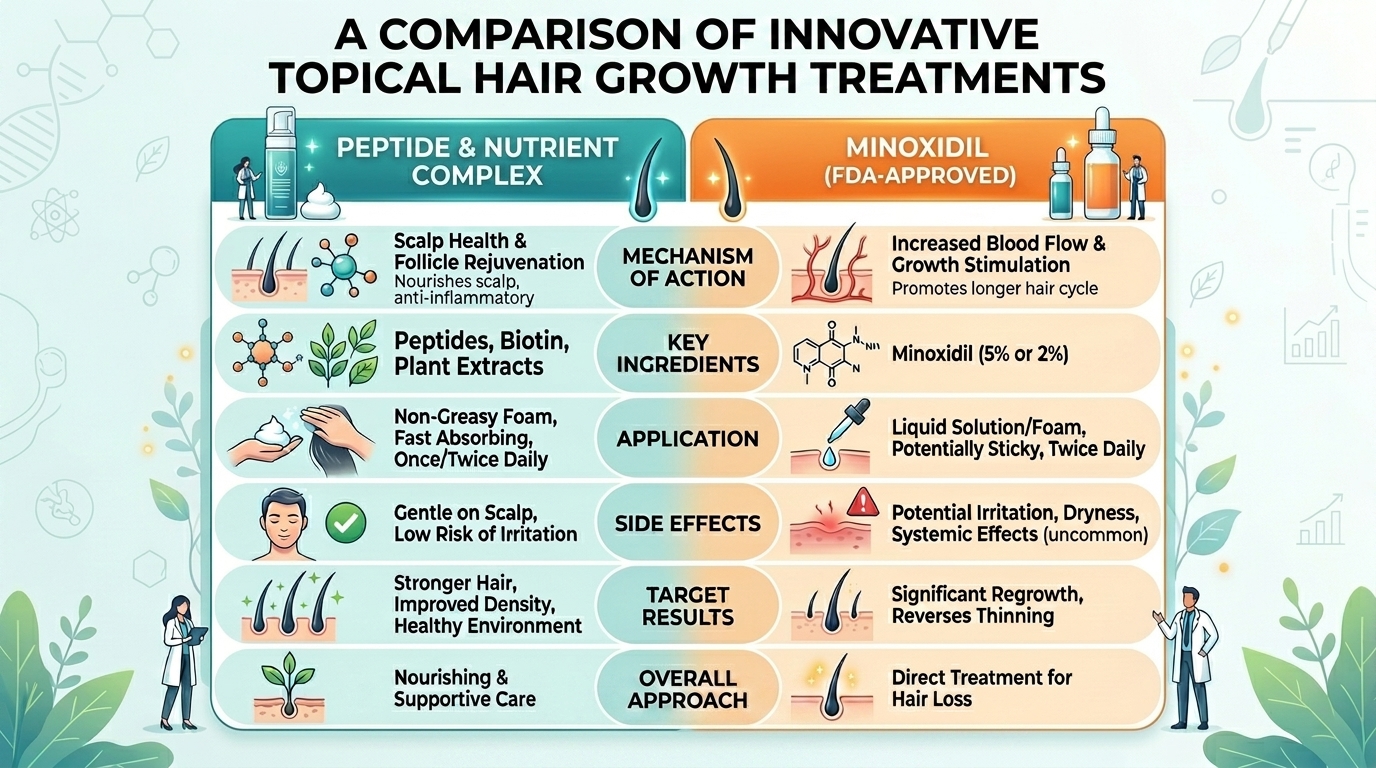
GHK copper peptide hair foam works by activating follicle stem cells and modulating gene expression related to hair growth. It also carries strong antioxidant and anti-inflammatory properties, addressing the root causes of follicle miniaturisation. Minoxidil, by contrast, relies on vascular stimulation and does not directly repair follicle damage. For people whose hair loss has an inflammatory or oxidative component, copper peptides may offer a more targeted benefit.
Clinical Evidence
Minoxidil has decades of large-scale clinical trial data supporting its effectiveness. A landmark study in the Journal of the American Academy of Dermatology found that 5% Minoxidil outperformed 2% in promoting hair regrowth in men with androgenetic alopecia. GHK copper peptide research, while compelling, is comparatively newer and smaller in scale, though the results in published dermatological studies are consistently promising.
Side Effects and Tolerability
One of the most significant advantages of GHK copper peptide hair foam is its tolerability profile. Users rarely report irritation, dryness, or scalp sensitivity. Minoxidil, on the other hand, is associated with scalp itching, dryness, and an initial shedding phase during the first 4 to 6 weeks, which can be alarming for new users. Additionally, Minoxidil can cause systemic side effects in rare cases when absorbed in higher amounts, particularly with the oral formulation.
Suitability by Hair Loss Type
For early-stage thinning, diffuse hair loss, or hair loss triggered by stress, nutritional deficiency, or inflammation, GHK copper peptide hair foam is arguably a more biologically appropriate starting point. For moderate to advanced androgenetic alopecia (pattern baldness) with established follicle miniaturisation, Minoxidil’s stronger clinical evidence base and greater potency may make it the more practical first-line choice.
Can You Use Both Together?
A growing number of dermatologists and trichologists recommend a combined approach. Copper peptides help repair and strengthen the follicular environment, while Minoxidil maintains blood flow and stimulates growth. Because they act through different mechanisms, using both is not only possible but may be synergistic.
Some advanced hair foam formulations already include copper peptides alongside other actives, such as biotin and saw palmetto, for this reason. If you consider combining treatments, a consultation with a certified dermatologist ensures the regimen is appropriate for your hair loss pattern and medical history.
Which Should You Choose?
There is no single answer, because the right choice depends on several individual factors. If your priority is a gentler, biologically driven approach with minimal side effects, and your hair loss is in its early stages, GHK copper peptide hair foam is a scientifically grounded and well-tolerated option worth trying. If you need faster, more aggressively proven results for moderate to significant pattern hair loss, Minoxidil remains the gold standard with the strongest regulatory backing.
For many people, the most effective regimen combines both: Minoxidil to stimulate blood flow and copper peptides to repair and protect follicle health.
Frequently Asked Questions
Q: Is GHK copper peptide better than Minoxidil for hair regrowth?
A: Both treatments are effective, but work through different pathways. GHK copper peptide is better suited to follicle repair and early-stage thinning, while Minoxidil has stronger clinical data for moderate to advanced androgenetic alopecia. A combination approach is often recommended by dermatologists.
Q: Can I use GHK copper peptide and Minoxidil together?
A: Yes. Many dermatologists suggest using both, as they complement rather than interfere with each other. Copper peptides can mitigate the scalp dryness sometimes caused by Minoxidil while supporting follicle repair. Always seek professional advice before beginning a combined regimen.
Q: How long does GHK copper peptide take to show hair regrowth results?
A: Most users notice reduced shedding and improved scalp texture within 8 to 12 weeks. Measurable improvements in hair density are typically observed after 4 to 6 months of consistent use.
Q: Does GHK copper peptide cause any side effects?
A: GHK copper peptide is generally very well tolerated. Reported side effects are rare and mild, typically limited to temporary redness in those with very sensitive skin. It does not carry the systemic risks associated with oral Minoxidil.
Q: Is Minoxidil safe for long-term use?
A: Topical Minoxidil has a well-established long-term safety profile when used as directed. It is important to note that hair regrowth achieved with Minoxidil typically reverses within several months of discontinuing use, making ongoing application necessary to maintain results.
Advance Your Longevity Journey
Our clinical team provides personalized senolytic assessments based on the latest research protocols.