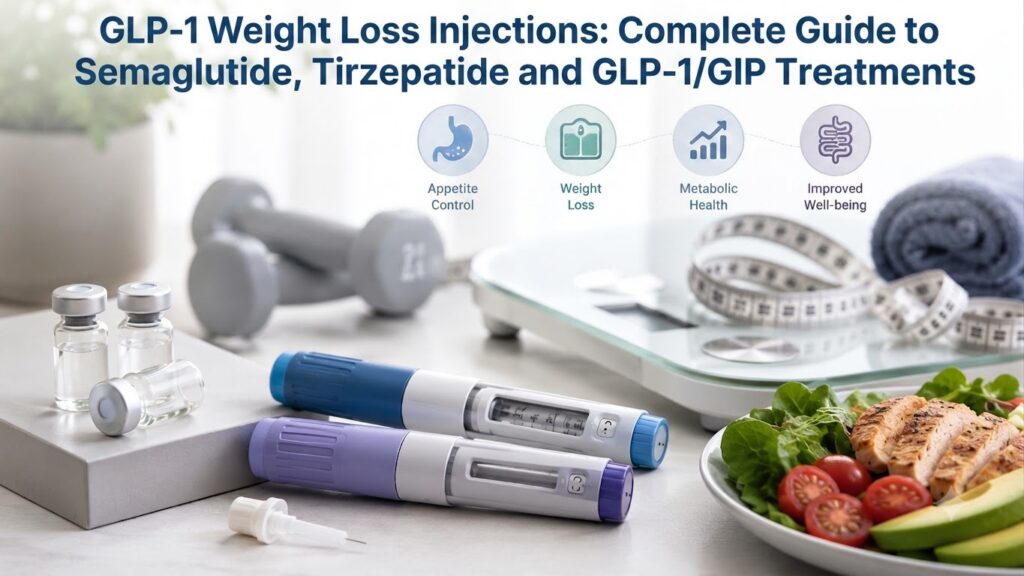

If you’ve been researching medical weight loss options, you’ve likely come across two categories of injectable medications that are reshaping how obesity is treated: GLP-1 receptor agonists like semaglutide, and the newer GLP-1/GIP dual agonists like tirzepatide. Both are once-weekly injections that reduce appetite and support meaningful, sustained weight loss. But they work through different mechanisms, produce different average results, and have slightly different side-effect profiles. Understanding which one is right for you starts with understanding what makes them different, not just in name, but in how they interact with your body.
What Are GLP-1 vs GLP-1/GIP Weight Loss Injections?
How GLP-1 Receptor Agonists Work
GLP-1 stands for glucagon-like peptide-1, a hormone your gut naturally releases after eating. It plays a direct role in regulating appetite, blood sugar, and digestion. When you eat, GLP-1 signals your brain that you’re full, slows the rate at which food moves through your stomach, and prompts your pancreas to produce insulin in proportion to blood sugar levels.
A GLP-1 receptor agonist, such as semaglutide, mimics this hormone artificially. By continuously activating GLP-1 receptors, it extends those same appetite-regulating effects throughout the day, making it easier to eat less without the constant mental battle of hunger.
Semaglutide is available under brand names such as Ozempic (for Type 2 diabetes) and Wegovy (for chronic weight management), and was FDA-approved for obesity treatment based on clinical outcomes showing an average body weight reduction of approximately 13-15% over 68 weeks.
How GLP-1/GIP Dual Agonists Work
Tirzepatide, sold as Zepbound for weight management and Mounjaro for diabetes, is a dual agonist. It activates both GLP-1 receptors and GIP (glucose-dependent insulinotropic polypeptide) receptors simultaneously.
GIP is another incretin hormone released in response to food. On its own, it has modest effects, but when combined with GLP-1 activation, something notable happens: the two pathways work synergistically. Research suggests that certain hypothalamic neurons respond more powerfully when both GLP-1 and GIP receptors are activated simultaneously, resulting in stronger appetite suppression and a greater impact on energy regulation.
In large clinical trials, tirzepatide produced an average weight loss of approximately 20 per cent of body weight over 72 weeks, which was meaningfully higher than that with semaglutide in head-to-head comparisons.

GLP-1 vs GLP-1/GIP Weight Loss Injections: Speed and Effectiveness
Which Works Faster?
This is where the data offers a nuanced answer. A 2025 model-based meta-analysis published in PMC found that semaglutide reaches its efficacy plateau sooner than tirzepatide in the treatment timeline. Tirzepatide tends to take longer to reach its maximum effect approximately 46 weeks compared to a shorter plateau window for semaglutide, but it ultimately produces a greater total reduction in body weight.
In practical terms, semaglutide may show noticeable results a bit earlier in the treatment window, while tirzepatide continues to accumulate weight-loss benefits as treatment progresses and achieves a higher overall ceiling.
Real-world data reinforces this. In a 12-month retrospective study comparing GLP-1-naive patients, those on tirzepatide lost an average of 10.2 kg while those on semaglutide lost an average of 6.1 kg over the same period.
Which Produces Greater Total Weight Loss?
Based on available evidence, tirzepatide consistently outperforms semaglutide on total weight loss across both clinical trials and real-world studies. A 2025 meta-analysis covering over 140,000 participants found that tirzepatide produced a mean difference of approximately 4.23 per cent greater weight loss compared to semaglutide.
For someone weighing 220 pounds, that difference is clinically meaningful.
Side Effects: What the Research Actually Shows
Both medications share a similar core side-effect profile, primarily gastrointestinal symptoms during early treatment and during dose escalation. Nausea, constipation, loose stools, and mild fatigue are the most commonly reported.
However, the comparison between the two is more nuanced than simply “which is worse.”
A comprehensive 2025 systematic review and network meta-analysis analysing 19 randomised controlled trials with over 13,500 participants found that GLP-1 receptor agonists like semaglutide were associated with higher rates of abdominal pain and dyspepsia, while tirzepatide showed a higher risk of severe hypoglycemia in certain patients. Tirzepatide also demonstrated superior safety profiles related to respiratory infections and inflammatory markers.
In general, most patients tolerate both medications, and side effects are most pronounced during dose escalation. Gradual titration, which involves starting at a low dose and increasing slowly over several weeks, is standard practice for both and significantly improves tolerability.
One Important Consideration
Neither medication is appropriate for individuals with a personal or family history of medullary thyroid carcinoma or multiple endocrine neoplasia syndrome type 2. Screening by a licensed clinician is essential before starting either therapy.
Which One Is Right for You?
Choosing Between GLP-1 and GLP-1/GIP Injections
This isn’t a decision to make based on a comparison article. It’s a conversation to have with a medical provider who understands your full health picture.
That said, here’s a useful framework:
Semaglutide is a well-established, extensively studied option with strong cardiovascular data (from the SELECT trial, which enrolled over 17,000 participants) and earlier, more visible results.
Tirzepatide tends to be preferred when greater total weight loss is the priority, when someone has not achieved sufficient results on semaglutide, or when the dual metabolic benefits of GIP activation, including its effects on insulin sensitivity and bone metabolism, are clinically relevant.
For patients who are new to injectable weight loss therapy with no prior GLP-1 experience, either medication can be a clinically sound starting point under proper supervision.
The Role of Medical Supervision in Both Therapies
It is worth emphasising what the clinical data consistently show: both medications produce their best results when combined with structured lifestyle support. That means working with a clinical team on nutrition, activity, sleep, and behavioural strategies alongside the medication.
Medication addresses the biology. The lifestyle framework builds the long-term foundation.
At Green Cap Health, our licensed clinicians guide patients through personalised, physician-led weight management programs. We evaluate your metabolic health, medical history, and goals before recommending any injectable therapy — and we support you through every stage of treatment.
Explore our weight management programs at Green Cap Health. Schedule a consultation with our clinical team.
Frequently Asked Questions
Q: Can I switch from semaglutide to tirzepatide if it’s not working well enough?
A: Switching between medications is possible, but must be managed by a licensed provider. It typically involves restarting the new medication at a lower dose rather than continuing at the same dose to ensure tolerability and safety.
Q: Is tirzepatide always better than semaglutide for weight loss?
A: On average, tirzepatide produces greater total weight reduction in clinical trials and real-world data. However, individual responses vary based on genetics, metabolic health, adherence, and lifestyle factors. The “better” medication is the one that works for your specific situation under medical guidance.
Q: How long does it take to see results from GLP-1 or GLP-1/GIP injections?
A: Most patients begin noticing reduced appetite within the first 2 to 4 weeks. Visible weight changes typically become apparent after 8 to 12 weeks, with continued progress through the full treatment period. Both medications continue producing results beyond the 6-month mark.
Q: Are GLP-1 and GLP-1/GIP injections safe for long-term use?
A: Both are intended for long-term chronic weight management under medical supervision. Clinical trials spanning over a year have demonstrated sustained weight loss and metabolic benefits. Long-term safety monitoring is a standard part of any responsible treatment plan.
Q: What happens if you stop taking these injections?
A: Weight often returns after stopping either medication, which is why they’re designed for ongoing use as part of a comprehensive metabolic health strategy rather than a short-term course.
Advance Your Longevity Journey
Our clinical team provides personalized senolytic assessments based on the latest research protocols.