

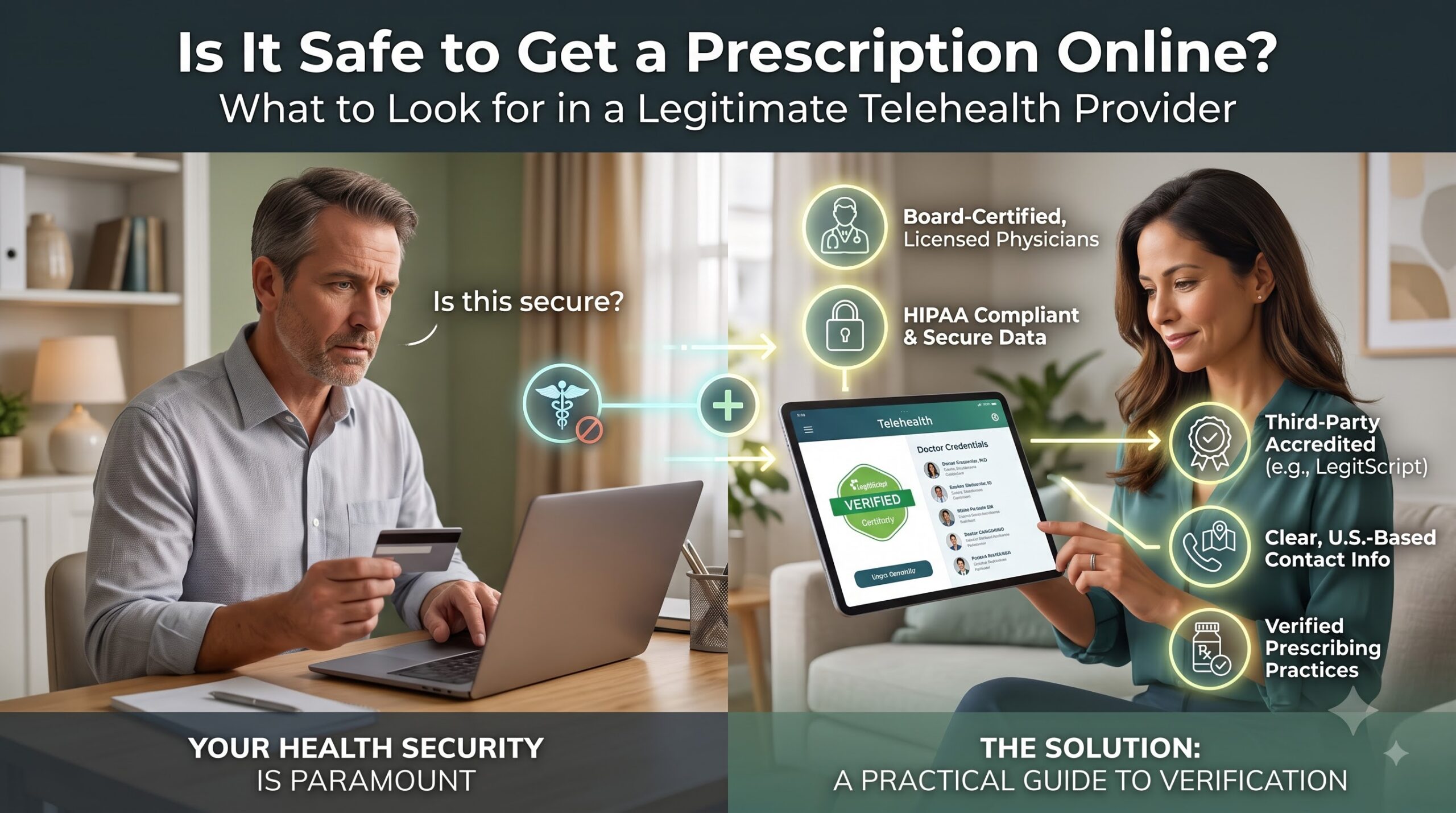
Online prescription safety is a legitimate concern, and it is one that every responsible telehealth platform should be prepared to answer clearly and specifically. The honest answer is that getting a prescription online is safe when the provider is properly licensed, the clinical process involves a real evaluation by a real provider, and your health data is protected by the same standards that apply in any other healthcare setting. The problem is that not every platform operating in this space meets those conditions, and the consequences of using an illegitimate one range from receiving a prescription that was never clinically reviewed to having your personal health data handled without appropriate protection. This guide explains exactly what makes an online prescription safe, how to verify that a provider meets those standards, and what red flags to walk away from.
Is It Safe to Get a Prescription Online?
Getting a prescription online is safe when the telehealth provider is licensed in your state, employs real licensed clinicians to review your case, and operates on a HIPAA-compliant platform. The clinical safety of an online prescription depends entirely on whether the prescribing process involves genuine clinical judgment, a real provider reviewing your history, evaluating your symptoms, and making an informed decision rather than an algorithm approving a checkout.
The legal framework governing online prescribing is more robust than most people realize. Under the Ryan Haight Online Pharmacy Consumer Protection Act, a prescribing practitioner may remotely prescribe controlled substances to a patient only after conducting at least one in-person medical evaluation, subject to specific exceptions for DEA-registered practitioners operating under current telemedicine flexibilities. For non-controlled medications, the category covering most telehealth prescriptions for weight loss, skincare, hair regrowth, sexual health, and primary care, the requirements center on licensed providers, legitimate patient-provider relationships, and pharmacy compliance standards.
How to Verify a Legitimate Telehealth Provider
A legitimate telehealth provider can be verified across five specific criteria. Checking all five takes less than ten minutes and removes nearly all of the risk associated with online prescribing.
LegitScript Certification: What It Means and Why It Matters
LegitScript is an independent verification organization that certifies online pharmacies and telehealth platforms against a defined set of legal, compliance, and clinical standards. A LegitScript-certified provider has been audited and confirmed to operate within applicable federal and state pharmacy and prescribing laws, to dispense only FDA-approved or FDA-compliant medications, and to maintain appropriate privacy and data security standards.
LegitScript certification is not self-reported. It is granted by an external body, renewed regularly, and revocable if standards are not maintained. When evaluating a telehealth provider, searching their name on the LegitScript verification directory at legitscript.com takes less than two minutes and tells you whether they hold current certification.
DEA Registration and State Licensing: What to Check
Every provider who prescribes controlled substances through a telehealth platform must hold a valid DEA registration. Under the DEA’s fourth temporary extension, issued December 31, 2025, DEA-registered practitioners are permitted to remotely prescribe Schedule II through V controlled medications via audio-video telemedicine encounters through December 31, 2026, without a prior in-person evaluation, provided prescriptions comply with DEA guidance and applicable federal and state law.
For non-controlled prescriptions, the relevant check is state medical board licensing. The provider writing your prescription must be licensed in the state where you are located at the time of the visit. Most legitimate telehealth platforms list the states they operate in and the license status of their clinical team. If that information is not visible on the site, that itself is a warning sign.
You can verify a provider’s license directly through your state medical board’s public license lookup tool, which is available for every US state. You can also verify a provider’s DEA registration through the DEA’s official online registration tool.
HIPAA Compliance and Data Privacy: The Non-Negotiable Standard
Every telehealth platform that handles protected health information, including your intake questionnaire, diagnoses, and prescription records, is required by federal law to comply with HIPAA. HIPAA compliance means your health data is stored and transmitted using encrypted systems, is not sold to third parties, is not shared with your employer or insurer without your explicit consent, and is handled by staff trained in data privacy obligations.
A legitimate provider states its HIPAA compliance explicitly and can explain what it means in practice. An illegitimate one may mention privacy in vague terms without specifying the standards it follows. If a platform’s privacy policy is difficult to find, written in language designed to obscure rather than clarify, or if it reserves the right to share your data with “partners,” treat that as a significant red flag.
Compounded Medications: What to Ask Before You Fill
Many telehealth prescriptions, particularly for GLP-1 weight loss medications, hair loss treatments, and skincare formulations, involve compounded medications rather than commercially manufactured drugs. Compounding is legal and widely used in legitimate clinical practice, but the safety of a compounded medication depends directly on where its active ingredients are sourced.
A legitimate telehealth provider sources compounding ingredients exclusively from FDA-registered facilities, which means the raw materials meet the same purity and quality standards used in commercial manufacturing even when the final formulation is not itself FDA-approved. Ask explicitly: where are the active ingredients in this formulation sourced, and are those suppliers FDA-registered? A trustworthy platform answers this question without hesitation.
Red Flags That Signal an Illegitimate Online Prescription Provider
The warning signs of an illegitimate online prescription provider are specific and recognizable once you know what to look for.
No real clinical review: If a platform offers to prescribe after only a written questionnaire with no provider consultation, no video or phone appointment, and no follow-up mechanism, the prescription is not being written by a licensed clinician making a real clinical decision. It is being generated by a system designed to maximize throughput rather than protect your health.
No verifiable state licensing: Legitimate providers list the states where they are licensed to prescribe. If you cannot confirm that the provider serving you is licensed in your state, the prescription may not be legally valid and may not be covered by any pharmacy.
Pricing that seems designed to hide costs: Bait-and-switch dosing tiers, undisclosed dispensing fees, and pricing structures that change after enrollment are operational patterns associated with platforms prioritizing revenue extraction over clinical integrity. A legitimate provider publishes its pricing clearly and completely before you commit.
No LegitScript certification or equivalent third-party verification: The absence of any independently verified legitimacy credential does not automatically mean a platform is operating illegally, but it does mean you are relying entirely on the platform’s self-description rather than external validation.
No physical pharmacy address or pharmacy license number: Every prescription dispensed through a legitimate telehealth platform should be filled by a licensed pharmacy with a verifiable physical address and state pharmacy board license. If you cannot identify where your medication is being dispensed from, that is a significant gap.
How Green Cap Health Meets the Legitimate Telehealth Standard
Green Cap Health is a licensed Texas telehealth pharmacy that explicitly meets every standard described in this guide. Green Cap Health holds LegitScript certification, operates on an encrypted HIPAA-compliant platform, sources all active ingredients exclusively from FDA-registered facilities, and has every prescription reviewed and approved by a licensed Texas doctor, nurse practitioner, or pharmacist with real clinical judgment, not an algorithm making the call.
Pricing is flat and published in full before any commitment. There are no hidden dispensing fees, no bait-and-switch dosing tiers, and no data sharing with employers, insurers, or third-party marketing partners. The clinical team is Texas-licensed, which means prescriptions are valid for patients located in Texas at the time of the visit.
For patients evaluating telehealth providers for weight loss, skincare, hair growth, or sexual health prescriptions, Green Cap Health’s LegitScript certification and transparent clinical process represent the baseline standard of what a legitimate provider looks like in practice.
Verify Green Cap Health’s LegitScript Certification →
Learn How Green Cap Health’s Prescription Process Works → Start a Health Assessment →
FAQ’s
Q: Is it safe to get a prescription online?
A: Yes, when the provider is properly licensed in your state, employs real licensed clinicians who review your case individually, and operates on a HIPAA-compliant platform. The safety of an online prescription depends on whether there is genuine clinical judgment involved, a real provider evaluating your history and symptoms rather than an automated system approving a request. Verifying LegitScript certification, state licensing, and HIPAA compliance before using any telehealth platform significantly reduces risk.
Q: How do I verify that an online prescription provider is legitimate?
A: Check five things: LegitScript certification (searchable at legitscript.com), state licensing for all providers serving you (verifiable through your state medical board’s public license lookup), DEA registration if controlled substances are involved (verifiable through the DEA’s official registration tool), HIPAA compliance as stated in the privacy policy, and the sourcing of any compounded medication ingredients (should be from FDA-registered facilities). A legitimate provider can answer questions about all five without hesitation.
Q: What is LegitScript certification and why does it matter?
A: LegitScript is an independent third-party verification organization that audits online pharmacies and telehealth platforms against legal, compliance, and clinical standards. A LegitScript-certified provider has been externally verified to operate within applicable prescribing and pharmacy laws and to meet data privacy and medication safety standards. It is the most widely recognized independent legitimacy signal for online prescription services in the US.
Q: Are compounded medications from telehealth providers safe?
A: Compounded medications are legal and clinically legitimate when prescribed appropriately and dispensed by a licensed compounding pharmacy using ingredients from FDA-registered facilities. The safety of a compounded medication depends on where its active ingredients are sourced. Before filling any compounded prescription through a telehealth provider, confirm that the platform uses FDA-registered ingredient sources; a legitimate provider discloses this proactively.
Q: What are the biggest red flags of an illegitimate online prescription site?
A: The most significant red flags are: a prescription issued without a real clinical review (questionnaire only, no provider consultation), inability to verify the prescribing provider’s state license, no LegitScript or equivalent third-party certification, pricing structures that change after enrollment or include undisclosed fees, and no verifiable pharmacy address or license. Any one of these warrants walking away.
Q: Does the DEA regulate online prescriptions?
A: Yes. The DEA has extended telemedicine flexibilities through December 31, 2026, allowing DEA-registered practitioners to remotely prescribe Schedule II through V controlled medications via audio-video telehealth encounters without a prior in-person evaluation, provided prescriptions comply with DEA guidance, DEA regulations, and applicable federal and state law. For non-controlled medications, the relevant regulatory framework is state medical board licensing combined with pharmacy board compliance standards.

Advance Your Longevity Journey
Our clinical team provides personalized senolytic assessments based on the latest research protocols.